|
Green Roof
Advantage

Source: Energy Emissivity Analysis of GSU Rooftops, 1998
During
the 8-week GSU project, in situ measurements of the
surface temperature of twenty building rooftops were taken with
an infrared thermometer in June and compared with the remotely
sensed data set of May 1997. Four basic roof systems were
studied, tar and gravel, asphalt and gravel, modified bitumen,
and EPDM-B. The initial results of the study do not generally
indicate significant differences between surface temperatures
and the four roof systems. However, the black EPDM-B without a
river rock covering was significantly hotter, approximately 25
degrees Fahrenheit, than the EPDM-B with river rock (8).
Examples of the EPDM-B roof cover is provided in (figure 4).
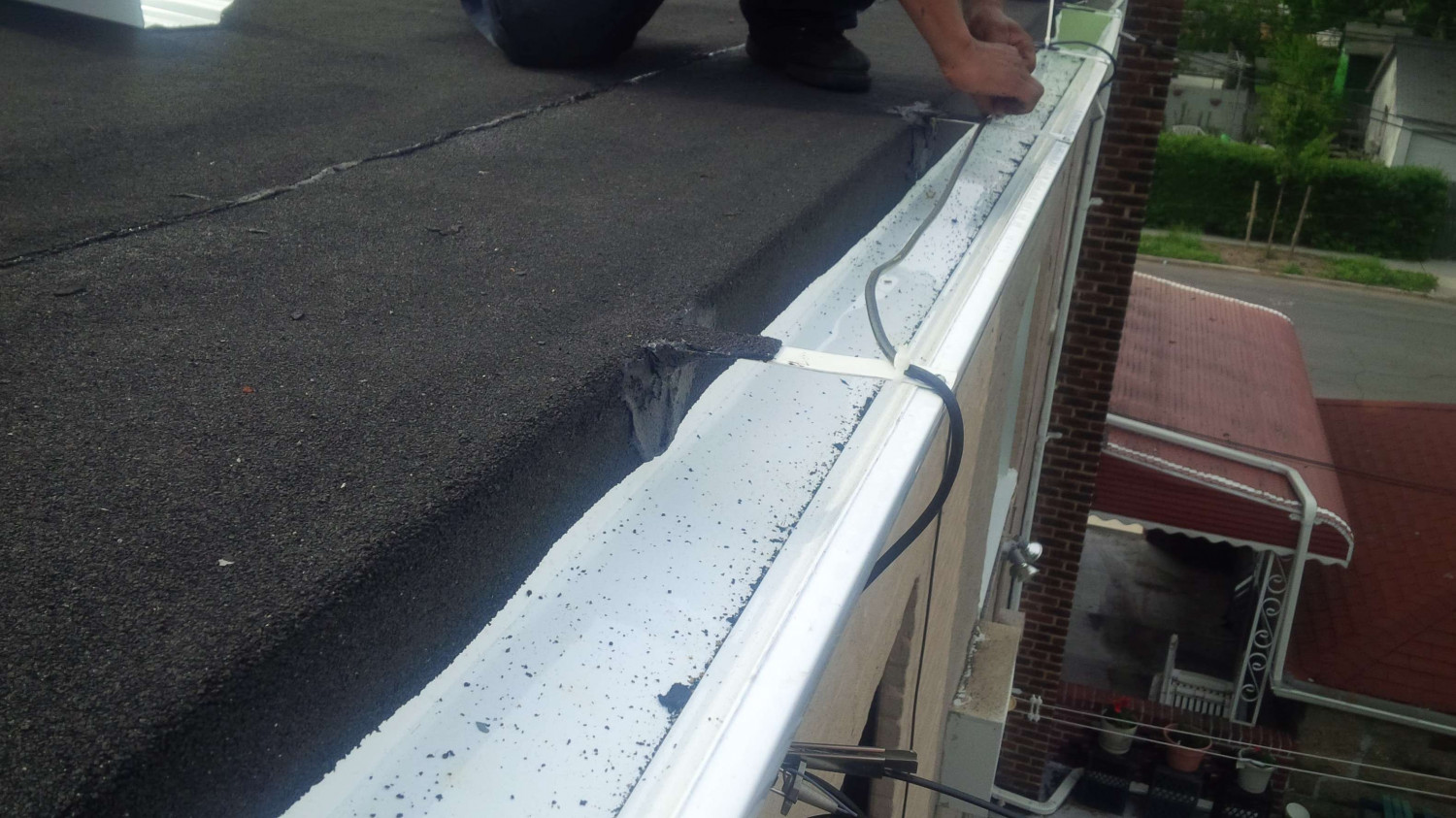
The most interesting result was a strong
correlation between older gravel surfaced coal tar pitch roofs
and higher surface temperatures. The gravel-surfaced
coal tar pitch roof is common in commercial areas throughout the
United States. As the roof deteriorates through exposure to
sunlight and weather, the flow of bitumen allows gravel to
become more embedded, exposing the dark colored bitumen to
greater solar loading (9) This causes the roof surface to become
hotter as shown in (figure 5).
Figure 5: Deteriorating gravel surfaced
coal tar pitch roof.

Source: Energy Emissivity Analysis of GSU Rooftops, 1998
It has been suggested that the study could
be expanded to include white thermal plastics, white-coated
membranes, and metal roofs to provide a more comprehensive
analysis of the majority of roofing types present within the
Atlanta metropolitan area. More study on the role of insulation
and roof surface temperatures is also desirable to correctly
interpret results.
A CD-ROM with all flight lines
georeferenced in a variety of image file formats has been
developed. The georeferenced datasets on CD-ROM has been
provided to the Atlanta Regional Commission (ARC) and Georgia
Tech Geographic Information System laboratory. Thermal color
wall size work maps of three flight lines over the heart of the
Atlanta Central Business District and surrounding area have been
developed to identify "hot spots" and other areas for further
study. The maps are approximately 2.5 feet in width and 5 feet
in length.
As we have worked in Atlanta, it has
become apparent that a local presence would significantly
facilitate ongoing efforts to share data with planners,
decision-makers, and others. Also, to enable these end users to
effectively utilize research results in new policies or the
daily conduct of business.
Conclusions and Future Plans
- A significant number of key
stakeholders are interested in the urban heat island
research project and in finding ways to mitigate the heat
island and improve the quality of the Metropolitan Atlanta
environment.
- Establishing a local presence is
essential to maintaining the interest of key stakeholders
and in the ultimate use of project results for the benefit
of the community.
- Leveraging resources to engage more
students and faculty in the project is needed to address a
reasonable portion of the applied research needs identified.
- Effective data transfer to high end
users such as the ARC and Georgia Tech GIS unit remains a
challenge, particularly in providing data in a "standard"
format that can be ingested by different computer hardware
and software.
Planned Activities for 1999.
- Check and refine georeferencing of
all flight lines.
- Provide wall size thermal color work
maps of additional flight lines as needed.
- Determine an appropriate
classification scheme and produce a preliminary land cover
classification for the study area.
- Engage faculty and students in the
project for research support as possible by externally
funded research and education programs.
- Begin to perform analyses of thermal
responses by land cover types.
- Keep the application working group
updated and assist them with keeping key stakeholders
engaged in developing and implementing urban heat island
reduction plans.
- Write collaborative proposals to
pursue applied research objectives.
- Publication of the results from
Project ATLANTA in the open refereed literature.
Salt Lake City Cool Communities Program
Population, urban expansion and commercial
development are on the rise in metropolitan Salt Lake City. In
the last six years alone, Utah has experienced an unprecedented
economic boom, attracting large numbers of residents from other
states. Current Salt Lake metropolitan projections show a
sixty-five percent surge in population, up to 1.3 million
residents along the Wasatch Front by 2020. This, coupled with a
consistently growing residential population, has resulted in
tremendous urban expansion and development.
As a result of Salt Lake City’s unique
geographical conditions, with the Wasatch Mountains bordering
the east and the Oquirrh Mountains and Great Salt Lake bordering
the west, the Wasatch Front area experiences unique air quality
conditions that result in high levels of ground level ozone in
the summer, precipitated by criteria pollutants such as NOx and
VOC’s, and an unsightly and hazardous inversion in the winter.
In fact, the new EPA standard for ground layer ozone which
measures ozone over an eight-hour period and considers the air
dangerously polluted when ozone concentration exceed .08 parts
per million, was exceeded 68 times on 21 days across the state
last summer. (10)
Emerging development and urban growth
currently underway in Salt Lake City cause energy, air quality
and environmental problems that could adversely affect the
people and children that live and work in this uniquely situated
city. Planners, developers, community leaders and the public at
large in the Salt Lake City area need reliable and practical
information and support to implement strategies in their
neighborhoods that reduce energy consumption, improve air and
water quality, manage storm water runoff, provide habitat for
urban wildlife and improve the overall comfort, livability and
economic vitality of their urban neighborhoods.
Cool Communities is a collaborative
federal and local program designed to implement practical
strategies that reduce peak load electrical consumption,
mitigate the development of urban heat islands and directly
improve air quality. These strategies include 1) the use of
"cool" roof and street surfaces that are light-colored and
reflect incoming solar radiation as opposed to absorbing and
emitting it back into the environment, thereby reducing surface
and ambient air temperatures, and 2) the use of strategically
planted, drought tolerant deciduous and coniferous trees, shrubs
and ground covers that evaporate cool water vapor into the air
while directly shading and protecting buildings, streets, and
parking lots.
Salt Lake City became a Cool Communities
pilot in November, 1995. Its primary local partners include the
Utah Office of Energy Services and Tree Utah. The program is
operated through a broad based steering committee with members
from a variety of professional fields, including architecture,
landscape architecture, private industry, government, non-profit
and educational. Steering Committee members participate in four
working committees. These are: Research and Technical Committee,
Planning and Policy Committee, Implementation Committee, and the
Outreach and Education Committee.
In terms of air quality
improvements, Cool Communities’ strategies reduce electrical
demand associated with air conditioning because the program
seeks to mitigate urban heat islands, a prime source of heat in
cities. Overall, these reductions result in less cooling energy
demand by regional power plants, reducing the pollution
associated with the burning of fossil fuel. Another main
component of Cool Communities is the use of trees and vegetation
in the urban environment. Urban trees directly sequester CO2, as
well as PM(10) and other airborne particulate. Cool Communities
goals also include strategies that reduce citizen dependency on
the automobile. For example, narrow streets, tree-lined
sidewalks, bicycle paths, and downtown public transportation
provide citizens with pedestrian friendly and "green" urban
surroundings. These activities directly reduce automobile
emissions, which include NOx and CO2. With a de-emphasis on the
automobile, less expansive, heat producing parking areas are
needed, thereby reducing evaporative losses of VOC’s from
vehicular gas tanks. Also, parking areas that include trees and
light-colored surfaces produce cooler temperatures, resulting in
reduced need for automobile air conditioning, another air
quality concern.
In terms of energy consumption,
there is potential for Cool Communities to significantly save
energy. The combined use of strategically planted shade trees
and other vegetation with the use of light-colored, highly
reflective building and street surfaces have demonstrated
impressive reductions in energy consumption. For example,
computer simulations generated by Lawrence Berkeley National
Laboratory, demonstrate that the effect of planting three trees
around a typical house can save 18 - 44% of peak electrical
power, and up to 53% of the total annual cooling electricity
use. LBNL also estimates that a typical house with an albedo
(reflectivity level) of 90% consumed 60% less energy, had a 35%
lower peak electrical power demand, and experienced 44% fewer
cooling hours. Furthermore, the U.S. Department of Energy
predicts that if all the nation’s roads and buildings were
changed from black to light-colored, reflective surfaces,
approximately $4 billion a year could be saved annually in air
conditioning bills and smog could be reduced by 10%. |