In spring 1995, a group of roofing
professionals from around the world with
expertise in roof system design, roofing
forensics, material manufacturing and
material research convened in Brussels,
Belgium, to discuss an emerging idea
within the roofing
community—sustainability.
These roofing experts, who either are
members of the CIB (International Council
for Research and Innovation in Building
Construction) Working Commission W.83 or
RILEM (International Union of Testing and
Research Laboratories for Materials and
Structures) Technical Committee 166RMS,
met as part of a five-year task group to
determine the state-of-the-art design,
application and maintenance of
sustainable low-slope membrane roof
systems. Their committee work was titled
"Towards Sustainable Roofing
in NYC."
The committee members believed there
was a growing interest in sustainability
and enlightened building owners and roof
system designers were interested in
adopting roof systems that fit within
environmental parameters. On a universal
model, the parameters vary among regions,
countries and nations. The roofing
industry's challenge is to translate this
interest and good will into practical
guidelines that lead to improvements in
the long-term performance of roof
systems—within a given financial budget.
Background
The International Conference on
Climate Change held in 1997 in Kyoto,
Japan, challenged governments to improve
their national environmental performances
in terms of reducing pollution and energy
demand. To work toward these desirable
goals, the concept of "sustainable
development" actively is being promoted
in the contracting and property
industries in some countries.
Although this is a worldwide issue,
the United States currently has not
signed the treaty. However, there may be
a U.S. initiative at a future date.
It is unrealistic to believe any
product or procedure will be adopted if
it results in reduced performance. As an
architect specializing in roof system
design, I find my greatest challenge
designing environmentally responsive
low-slope roof systems is to exceed
anticipated service lives.
Defining the concept
During the initial committee meeting,
it was discussed that in developed
countries there was a growing concern
about the protection of the environment
during construction, as well as
maintenance of roof systems, which has
created an interest in design and
application criteria that promote or
limit harm to the environment. Practices
that consider the life-cycle costs of
roof systems and environmental effects
often are called "sustainable." The
committee members believed the trend
toward sustainable roofing would continue
to grow. Practices for sustainable
roofing may vary among countries or
regions.
The committee quickly realized that
before addressing sustainability
regarding roof systems and the
environment, it needed to define the
concept. Several organizations already
had attempted to define it, and the
committee wanted to consider all
definitions.

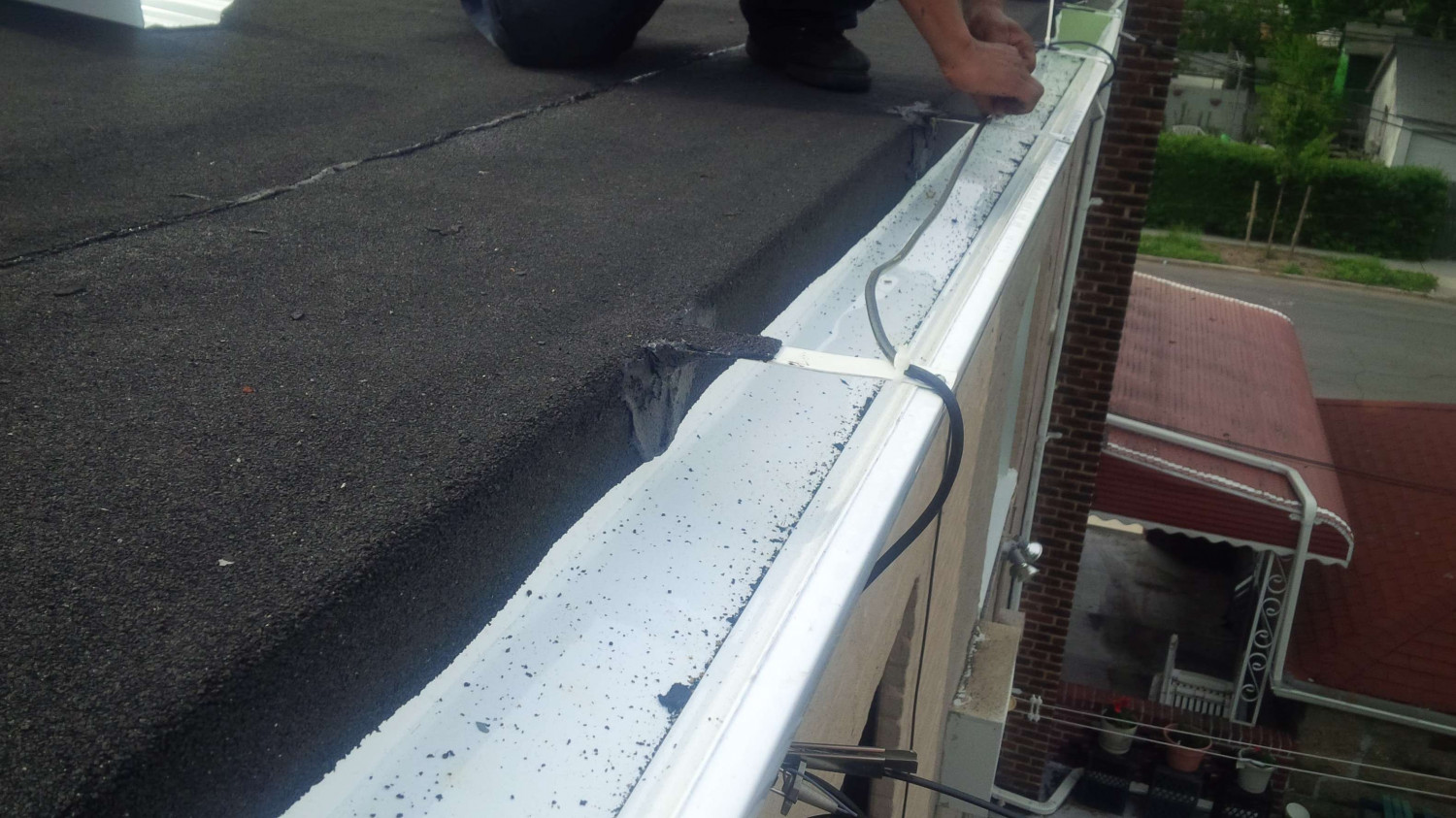
Brooklyn Jobsite
Photos
courtesy of Hutchinson Design Group
Ltd., Barrington, Ill.
These photos show
the use of thermal insulation
being installed by Brooklyn ROOFERS.
Tapered insulation, in an effort to
optimize thermal performance, can
greatly reduce heating and cooling
costs during the lifetime of this
roof system and building. Benefits
only will increase as energy costs
continue to rise (the installation
meets tenets 8, 9, 15 and 16). |
In 1987, the Brundtland Report, titled
"Our Common Future," was presented by Gro
Harlem Brundtland, former prime minister
of Norway, to the United Nations
Commission on the Environment and
Development. The report defined
principles of environmental sustainable
development as:
The development that meets the
needs of the present without compromising
the ability of future generations to meet
their own needs
The report became the defining work
with regard to sustainable development
worldwide and provided the committee with
the basis on which to pursue defining
sustainability with regard to low-slope
roof systems.
Attendees at the First International
Conference on Sustainable Construction
held in Tampa, Fla., Nov. 6-9, 1994,
defined sustainable construction
as:
The creation and maintenance of a
healthy built environment based on
ecologically sound principles and
resource efficiencies
Realizing the importance of defining
sustainable terminology, ASTM
International issued ASTM E2114-01,
"Standard Terminology for Sustainability
Relative to the Performance of
Buildings," in 2001. The standard defines
45 terms associated with sustainability.
Perhaps the best working definition of
what I understand to be a sustainable
roof system—and the definition the
committee accepted provided key areas
were addressed—was one used in the
Proceedings of the Sustainable Low-Slope
Roofing Workshop held at the Oak Ridge
National Laboratory (ORNL) facility in
Oak Ridge, Tenn., in October 1996. At the
workshop, a sustainable roof was
defined as:
A roof system that is designed,
constructed, maintained, rehabilitated
and demolished with an emphasis
throughout its life cycle on using
natural resources efficiently and
preserving the global environment
Translating this definition into the
19 languages of the committee members, as
well as other languages, was almost
unattainable and threatened to affect the
committee's work worldwide. For example,
in French, there is no word for
"sustainability," and in developing
countries that are struggling for
conditions of safety and health, the
concept of "life cycle" is quite foreign.
However, it was interesting to learn
that, in some of the poorest parts of the
world, the use of indigenous materials,
recycling and local labor has existed for
centuries out of necessity.
"Sustainable roofs" is difficult to
define, as well as implement and
comprehend. Sustainable development
supposes construction methods and their
relationships with the environment,
life-cycle analysis and environmental
quality must be taken into account.
Consequently, it is an all-encompassing
concept that provides a stable framework
for new design methods. What is meant
here is that by considering the whole, a
holistic view rather than a partial or
incomplete view is taken.
In a true sense for each of the
materials used in a roof system, the
amount of energy required to extract,
transport, manufacture, deliver, install
and reuse/recycle roofing materials
should be calculated. This concept,
called "embodied energy," quickly can
become extremely complex and
overwhelming. The committee believed the
design and construction community would
not and could not embrace this type of
analysis.
The committee reviewed the concerns
and ideas of its members, reviewed
research papers and published articles,
and identified the following key areas
where improvements could be made:
- Minimize the burden on the
environment, being responsible stewards
of Earth's resources
- Conserve energy, recognizing the
importance of savings benefits and
improving roof systems' thermal
efficiency
- Extend roof system lifespans,
realizing the worthiness of seeking
long-term performance
Tenets
The proper
application of a roof system,
especially in detail areas such as
this lap seam, will improve the
chances of optimizing long-term roof
system performance (meets tenets 13,
14 and 19). |
The committee believed if its work
were to have an effect within the design,
construction and roofing communities it
had to give practical advice that easily
was communicated, comprehended and
attainable. The committee believed
developing a one-page summary document
that could be referenced by designers,
roofing contractors and manufacturers
would be most beneficial. Out of this
idea arose the plan to use tenets
(principles or doctrines held in common
by members of an organization) to
summarize definitive goals under each key
area where improvements were needed.
In October 2000, the committee
finalized a summary of what appears to be
the best practices for sustainable
low-slope membrane roofing based on
published reports, technical papers and
the experience/expertise of the members.
Each tenet may appear to be simplistic or
common sense; however, when they are
considered as a whole, they make a
considerable contribution to promoting
sustainable roof system design,
construction and maintenance. (See "The
tenets of sustainability.")
The roofing industry
As owners and designers raise issues
about environmental concerns, the roofing
industry has responded with a number of
viable roof system design considerations.
Following is a summary of these trends
and concepts. Roof system designers
wishing to incorporate these concepts are
encouraged by the committee to
investigate the concepts' appropriateness
and potential for success. (For
information about how roofing materials
and products have been developed to
support sustainable roof system design,
see "Material
trends and improvements.")
CRRC and ENERGY STAR®
The Cool Roof Rating Council (CRRC) is
a nonprofit organization whose mission is
to provide a fair, accurate and
creditable radiative performance rating
system for roofing materials. The council
provides ratings for various roof
membranes with regard to reflectivity and
emissivity values based on the
appropriate ASTM test. Initial values and
three-year values are provided.
It should be noted that before
establishing a three-year value, ASTM
tests E903, "Standard Test Method for
Solar Absorptance, Reflectance and
Transmittance of Materials Using
Integrating Spheres"; E408, "Standard
Test Methods for Total Normal Emittance
of Surfaces Using Inspection-Meter
Techniques"; E1918, "Standard Test Method
for Measuring Solar Reflectance of
Horizontal and Low-Sloped Surfaces in the
Field"; C1549, "Standard Test Method for
Determination of Solar Reflectance Near
Ambient Temperature Using a Portable
Solar Reflectometer"; and C1371,
"Standard Test Method for Determination
of Emittance of Materials Near Room
Temperature Using Portable Emissometers,"
allow a roof covering material to be
washed prior to testing. I caution
designers and contractors against
accepting the same in-field values as
those provided by CRRC. The values given
are for comparison with other products,
not a promise of in-field performance.
ORNL has reported surface soiling can
degrade the potential energy saving by as
much as 50 percent.
ENERGY STAR is a program supported by
the U.S. Environmental Protection Agency
(EPA) and Department of Energy (DOE).
Products bearing ENERGY STAR labels are
said to be more energy-efficient than
standard products. ENERGY STAR-labeled
products include but are not limited to
appliances; heating, ventilating and
air-conditioning units; and lighting.
With regard to roofing, low-slope
products must have an initial solar
reflectance of 0.65 or greater and aged
reflectance value after three years of
0.50 or greater. Emittance is not
considered. Products that meet these
requirements without compromising product
quality and performance qualify for the
ENERGY STAR label. Manufacturers
voluntarily sign an agreement with ENERGY
STAR indicating compliance.
Green roof systems
Although prevalent in Europe, green
roof systems recently have made a
presence in North America. There are two
categories of green roof systems:
intensive and extensive.
Intensive systems are more substantial
green roof systems, incorporating trees
and bushes in a growth medium up to 1
foot (0.3 m). Substantial roof decks and
structures are required. Extensive green
roof systems are much less of a
structural burden, incorporating plants
with shallow roots to about 2 1/2 inches
(63.5 mm) deep. Technologies have been
developed so even lightweight roof decks
can support extensive roof gardens. The
greatest environmental benefits can be
obtained from intensive systems and
include reducing rainwater runoff, often
to less than 50 percent of typical
percentages; reducing pressure on
ground-level drainage systems; and
providing longer roof system service
lives because of the inherent protection
of roof membranes from ultraviolet (UV)
radiation, hail, wind and foot traffic.
Roof surface
reflectivity
Recent studies have found temperature
excursions occur on sunny days because of
heat-absorbing properties of the built
environment—buildings, roofs, walls,
roads, parking lots, etc.
This fully adhered
90-mil- (0.09-inch- [1.5-mm-]) thick
EPDM roof system
in Brooklyn was designed with
long-term performance as a key goal.
By achieving a highly
thermal-efficient, robust and durable
roof system, the building owner is
taking the long-term view, which is
the most important concept in
sustainability. (This installation
meets tenets 4, 8, 9, 10, 12, 13, 14,
15, 16, 18, 19 and 21.) |
ORNL and the Lawrence Berkeley
National Laboratories, Berkeley, Calif.,
hypothesize that a small reduction in
heat gain will result in substantial
energy consumption savings. In cases
where roof surfaces are black and
heat-absorbing, the concept of
reflectivity has been proposed as a way
to reduce urban heat temperatures.
Reflectivity is defined as a roof
surface's ability to reflect solar
energy. The greater a roof surface's
ability to reflect, the cooler the roof
surface, which could result in lower
air-conditioning demands but also can
increase the need for heating in
environments such as Chicago.
However, reflectivity will decline
over time because of UV radiation;
surface soiling from atmospheric
pollution and microscopic growths; acid
rain; moisture intrusion into roof
systems; wind; hail; and the temperature
cycling that occurs on all roof systems
because of climatic changes.
Physical changes in the properties of
a roof membrane or coating also can
decrease reflectivity. ORNL has published
studies indicating white roof systems
lose between 30 percent to 50 percent of
their reflectance with a corresponding
decrease in energy efficiency within the
first three years after being installed.
EPA and DOE have become involved and
developed the ENERGY STAR program, and
CRRC has developed a rating system for
white roof membranes. Membrane color is
one parameter for sustainability and
needs to be made within the whole concept
of a building system.
Using solar energy
Photovoltaic panels, which convert
sunlight energy to electricity without
consuming fuel or creating pollution, no
longer are tacked-on appendages begging
to be concealed. There are photovoltaic
materials available for virtually all
surfaces of a building envelope, such as
photovoltaic shingles and metal
standing-seam panels. As an enduring
symbol of environmental responsibility,
more and more building owners are willing
to pay an additional 1 percent or 2
percent of buildings' total construction
cost for photovoltaic roofing materials.
In some instances, excess solar energy is
"sold" back to utility companies.
The future
We all must realize our planet is
vulnerable. As we continue in the 21st
century, the ideals of sustainable
architecture and being environmentally
responsive will manifest themselves via
government mandates, building codes and
owner desires. Obtaining sustainable,
environmentally responsive roof systems
can be achieved by becoming educated
about the possibilities and using a
straightforward approach in adapting the
tenets of sustainable roofing where
possible. Materials, products and
construction techniques will continue to
evolve, and with them, the tenets of
sustainable roofing and concept of
designing for the long term will grow.
Those who take an active role in this
endeavor and embrace the concepts of
sustainable roofing will be ready for
future environmental challenges.
The committee's work on the topic of
sustainability is finished, and a copy of
the full report is available to CIB
members at
www.cibworld.nl/pages/begin/Pub271.html.
The committee's next task involves new
product introduction into the
marketplace.
Tom Hutchinson is principal of
Hutchinson Design Group Ltd., Barrington,
Ill. He is a CIB member and secretary of
CIB W.83.
The tenets of sustainability
Minimize the burden
on the environment
- Use products made from raw
materials whose extraction is least
damaging to the environment.
- Adopt systems and working practices
that minimize waste.
- Avoid products that result in
hazardous waste.
- Recognize regional climatic and
geographical factors.
- Where logical, use products that
could be reused or recycled.
- Promote the use of "green roof
systems" supporting vegetation,
especially on city roofs.
- Consider roof system designs that
ease the sorting and salvage of
materials at the end of the life of a
roof system.
Conserve energy
- Optimize the real thermal
performance of roof systems,
recognizing thermal insulation can
greatly reduce heating or cooling costs
during the lifetime of a building.
- Keep insulation dry to maintain
thermal performance and the durability
of a roof system.
- Use local labor, materials and
services when practical to reduce
transportation.
- Recognize embodied energy values
are a useful measure for comparing
alternative constructions.
- Consider the roof surface color and
texture with regard to climate and the
effect on energy and roof system
performance.
Extend roof system
life span
- Employ designers, suppliers,
contractors, tradespeople,
roofers and facility
managers who adequately are trained and
have appropriate skills.
- Adopt a responsible approach to
design, recognizing the value of a
robust and durable roof system.
- Recognize the importance of a
properly supported structure.
- Provide effective drainage to avoid
ponding.
- Minimize the number of penetrations
through a roof system.
- Ensure that high maintenance items
are accessible for repair or
replacement.
- Monitor roofing works in progress,
and take corrective action as
necessary.
- Control access onto completed roof
systems to reduce punctures and other
damage by providing defined walkways
and temporary protection.
- Adopt preventative maintenance with
periodic inspections and timely
repairs.
Material trends and improvements
Brooklyn Roofing material manufacturers slowly
have responded to the green roofing
movement by developing materials and
products that support sustainable roof
system design. Government mandates are
responsible for much of the push toward
development, but more clients/building
owners are requesting designs that
respect the environment during material
manufacturing, installation and
performance.
Following is an overview of some major
material developments in recent years.
Insulation
The Montreal Protocol, which banned
the production and importation of
HCFC-141b by the end of 2002, has had a
major effect on the polyisocyanurate
insulation industry. Reformulations
always are challenging, especially when
products with years of satisfactory
performance must be altered. The
conversion of all U.S. insulation
manufacturing facilities from HCFC-141b
to pentane-blown polyisocyanurates now
are complete.
Expanded polystyrene (EPS) and
extruded polystyrene (XPS) insulations
offer environmental benefits that need to
be considered when making insulation
selections. During its manufacturing
process, EPS emits no chlorofluorocarbons
(CFCs) or hydrochlorofluorocarbons (HCFCs)
into the atmosphere. EPS also is
recyclable. XPS has an extremely low
absorption rate and, as such, lends
itself to reuse even after decades of
in-place use, consequently saving money,
conserving insulation and minimizing
contributions to waste sites.
Adhesives
Contractors apply
foam adhesives have gained popularity,
and their use has increased dramatically
in recent years. Two-component
polyurethane spray foam adhesives contain
no HCFCs, and there are no U.S.
Environmental Protection Agency (EPA)
restrictions on using them in congested
areas.
Cold-process adhesives used with
bituminous products now can be formulated
for use in extreme environmental
conditions, and volatile organic compound
emission mandates require the use of the
most environmentally benign product
possible.
The requirements of achieving a
successful adhesive seam have changed
little. Clean roof surfaces, positive bonding
and mating of materials still are
required. What have changed are the
products used to achieve a bond. Splice
primers now are formulated without isocyanate; liquid adhesives are being
replaced with tapes; and flashing
materials are being manufactured with
tape adhesives laminated to flashings.
Wood blocking
An integral part of almost all roof
systems is the use of wood blocking. Wood
that is pressure-treated to enhance
protection against rot, decay and termite
attacks generally is recommended by roof
system designers and contractors.
Traditionally, CCA-treated wood, which
contained arsenic and chromium
(EPA-classified hazardous chemicals), was
used. There now are alternatives
available. Wood treated with ACQ,® a new
copper plus quat preservative system,
provides the same level of protection as
CCA preservatives without the arsenic and
chromium. Worker safety is a prime
benefit of using ACQ, and disposal of the
ACQ system into ordinary waste sites is
acceptable.
Asphalt
Odor probably is the most troubling
attribute of working with asphalt,
particularly when working on sensitive
facilities, such as hospitals, schools
and restaurants. Low-fuming, no-waste
packaged asphalt now is available.
Asphalt is packaged in containers that do
not require removal and melt without
affecting performance, thus reducing
waste. Formulations that include a
polymer that creates odor-trapping skim
layers now create a more comfortable
environment in the vicinity of a kettle.
Reinforcements
A number of roofing felt and modified
bitumen manufacturers now are
manufacturing reinforcing mats made from
reprocessed polyester, as well as
recycling and reducing waste to benefit
the environment.
White membranes and
coatings
The manufacture of additional types of
white membranes and coatings in response
to cool roof concepts and the ENERGY
STAR® Roof Products Program has increased
greatly during the past five years. Led
by the introduction of TPO membranes,
these materials have a variety of
formulations, and designers are cautioned
to research each product thoroughly for
its appropriateness in particular
designs.